When a foundation contractor talks to you about your home, the conversation starts with one basic question: slab or pier and beam? The answer determines everything — what can go wrong, how it’s diagnosed, and how it’s fixed. Here’s what you need to know.
Slab-on-Grade Foundations
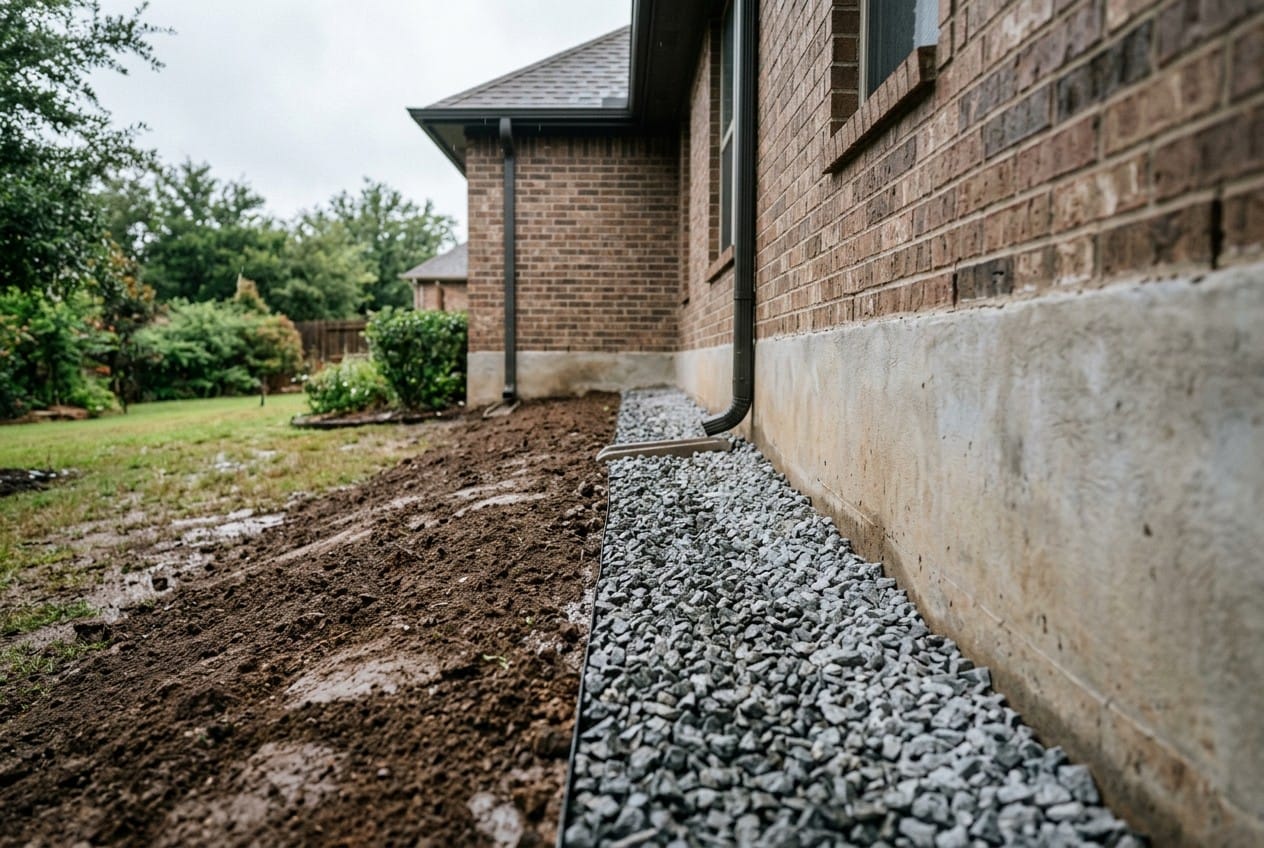
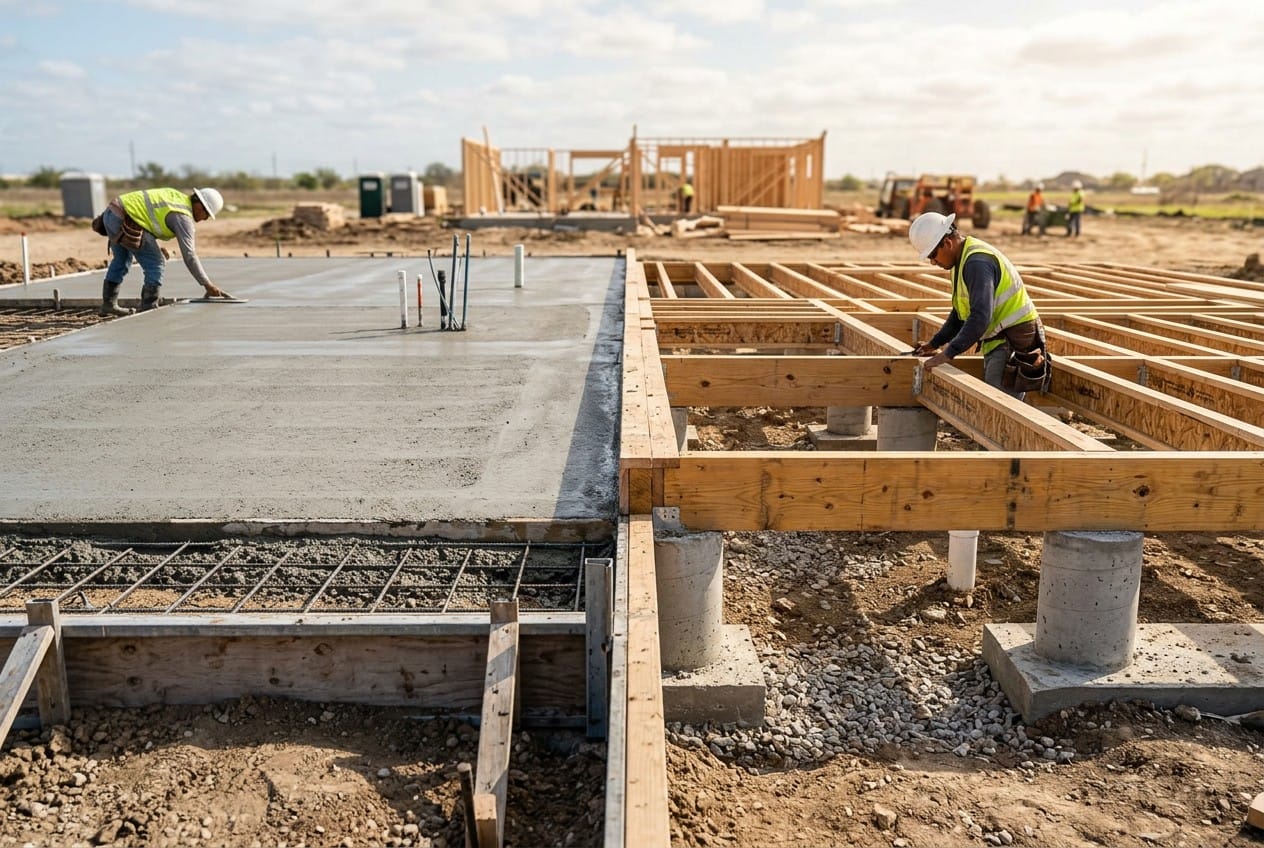
A slab-on-grade foundation is a single, continuous concrete pad — typically 4 to 6 inches thick — poured directly on the prepared soil. Most Texas homes built after the 1960s use this construction type, particularly in the DFW Metroplex, Houston suburbs, San Antonio, and Central Texas.
Why Texas builders chose slabs
- Faster and less expensive to construct than pier-and-beam
- No enclosed crawl space means less concern about wood rot and pest access
- Works well with concrete post-tension cable systems that can accommodate some soil movement
The slab’s achilles heel: expansive clay
The problem is that Texas clay soils move. When they dry out (often in summer and fall) they shrink; when they get wet they expand. That movement exerts uneven pressure on the slab from below. The perimeter — which is exposed to more weather and moisture variation — often settles differently than the center, leading to the classic “edge settlement” pattern seen across Texas neighborhoods.
Repairs for slab foundations typically involve driving steel or concrete pressed piers beneath the perimeter to reach stable soil or bedrock. Interior pier work is less common but sometimes necessary when the center of the slab heaves upward.
Pier-and-Beam Foundations
Pier-and-beam (also called post-and-beam) foundations elevate the home on a grid of concrete or wood piers. A network of beams spans between the piers, and the floor system sits on top. This style is more common in:
- Older homes (pre-1960s) across Austin, Houston, and inner Dallas neighborhoods
- Areas with high moisture or flood-prone lots
- Homes in parts of East Texas with sandy or poorly draining soils
The crawl space advantage
The enclosed crawl space between the floor and the ground is both the design’s strength and its vulnerability.
Advantages:
- Easy access to plumbing, HVAC ducts, and wiring
- Repairs are often less invasive — contractors work from below rather than drilling through the slab
- Individual piers can be shimmed, replaced, or augmented without disturbing the living area
Vulnerabilities:
- Wood components (beams, joists, sills) are exposed to humidity, standing water, and pests
- Inadequate ventilation can lead to moisture accumulation and wood rot — a very common issue in humid Houston and East Texas climates
- Crawl space encapsulation or vapor barrier work adds to overall maintenance costs
How to Tell Which Foundation You Have
The quickest check: look for an access hatch on an exterior wall near grade level, or a crawl space door in a closet floor. If you find one, you have pier and beam. If the home sits almost at grade with no visible crawl space, it’s almost certainly a slab.
You can also look at your home’s age and location as rough guides — though these are generalizations, not guarantees.
Does Foundation Type Affect Repair Cost?
Yes, but not always in the way homeowners expect. Pier-and-beam repairs are often less expensive for isolated issues (a sunken pier, a rotted beam section) because access is easier. Slab repairs can involve more equipment — hydraulic lifting rigs, tunneling for interior piers — which raises labor costs. The scope of movement and number of piers needed ultimately matters more than foundation type alone.
For a detailed cost breakdown, see our guide: How Much Does Foundation Repair Cost in Texas?
Whether you have slab or pier and beam, compare vetted Texas foundation contractors who work with both systems, or browse by city to find local specialists.
FAQ
Can a slab foundation be converted to pier and beam?
This is technically possible but rarely done — it’s extremely expensive and disruptive. Most homeowners with slab foundations who want improved access to utilities instead opt for selective tunneling or concrete saw-cutting, not a full foundation conversion.
My pier-and-beam home has soft or bouncy floors — is that a foundation problem?
Not necessarily. Soft or springy floors in pier-and-beam homes can result from undersized floor joists, rot in the subfloor, or missing blocking between joists — none of which are foundation issues. A contractor inspection will differentiate between structural pier problems and ordinary subfloor issues.
Are steel piers or concrete piers better for Texas soil?
Both are widely used. Steel push piers and helical piers are driven deeper and are better suited to reaching firm soil at greater depths. Concrete pressed piles (cylinders) are a more affordable option common in North Texas clay. The right choice depends on your soil profile, load requirements, and budget — a qualified contractor will assess all three.