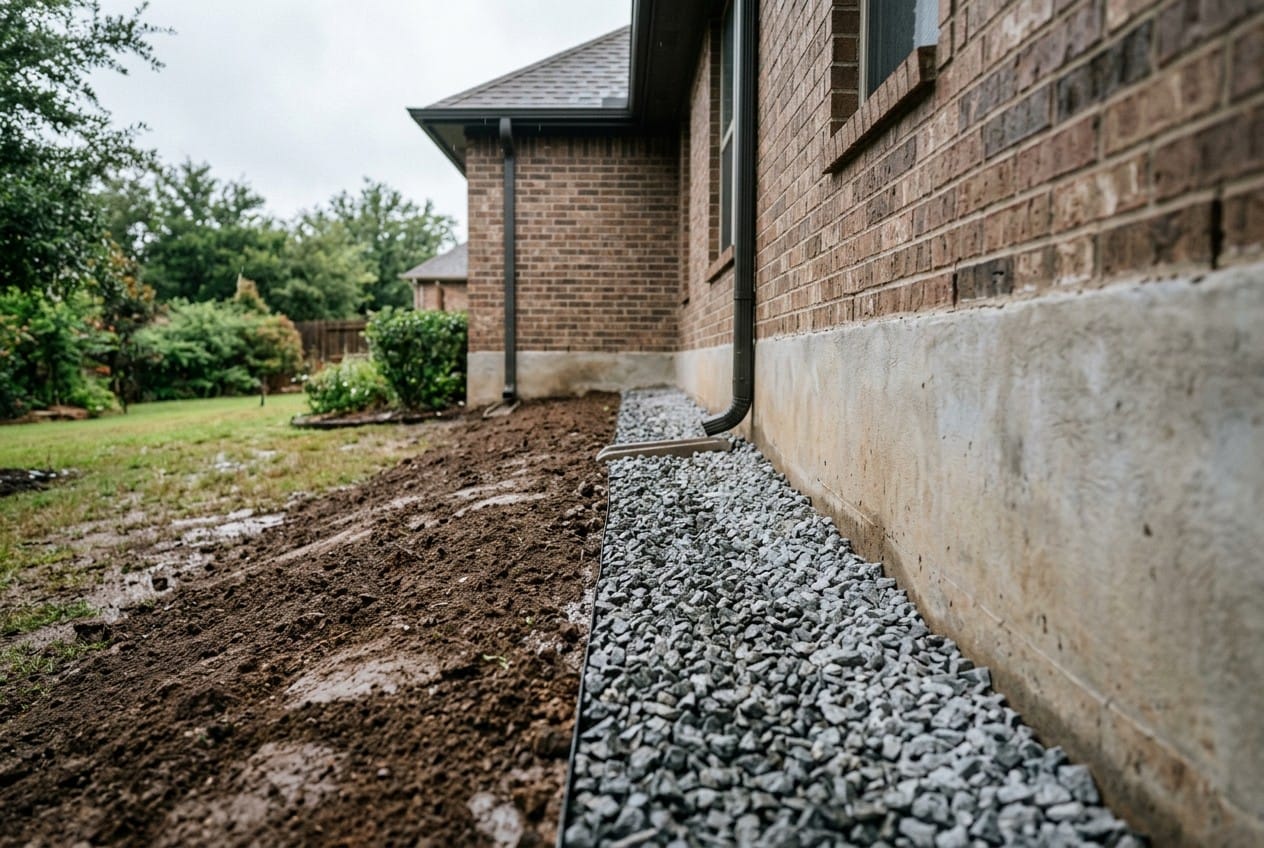
If there is one thing Texas foundation contractors say again and again, it’s this: water management is foundation management. The state’s expansive clay soils respond dramatically to moisture changes, and the way water moves — or fails to move — around your home determines how much stress your foundation endures through every wet and dry cycle.
The good news is that many drainage problems are visible and fixable before they cause significant structural damage.
Why Drainage Matters So Much in Texas
Texas alternates between prolonged droughts and intense rainfall events. During dry periods, clay soil shrinks and pulls away from the foundation’s perimeter. During heavy rains, water that pools against the foundation saturates that same soil and causes it to swell — and if drainage is poor, that saturated zone stays wet far longer than surrounding areas.
This uneven moisture creates uneven soil pressure on the slab or piers. One section of the foundation is sitting on shrunken, low-support soil while another is being pushed upward by oversaturated clay. Over years, this differential movement is what causes slab cracking, sticking doors, and sloping floors.
Common Drainage Problems Around Texas Homes
Negative grade (sloping toward the house)
The ground immediately next to your foundation should slope away — ideally dropping at least 6 inches over the first 10 feet. When soil settles over time, that slope often reverses, directing rainwater toward the foundation rather than away. This is one of the most common and easiest-to-fix drainage problems.
Fix: Re-grade the soil using compacted fill, then re-establish turf or groundcover. Avoid piling organic mulch against the foundation — it retains moisture.
Downspouts discharging too close to the foundation
If your gutters drain into splash blocks less than 4–6 feet from the house, or if downspouts terminate directly against the foundation, every rainfall is essentially a targeted moisture dump against your slab perimeter.
Fix: Extend downspouts with corrugated piping at least 6–10 feet from the foundation, or connect them underground to a pop-up emitter in the yard. This is inexpensive and can make a meaningful difference.
Planting beds that trap moisture
Dense, heavily mulched planting beds against the foundation look attractive but function as moisture reservoirs. The mulch slows evaporation, keeping the soil adjacent to your slab wet long after rain events.
Fix: Keep mulch at least 6 inches away from the foundation wall. Consider replacing dense plantings directly against the house with gravel or rock that promotes faster drainage.
Low spots in the yard that don’t drain
Standing water anywhere in your yard that takes more than 24–48 hours to absorb is a drainage problem. Even if the pooling is 20–30 feet from your house, the water table effect can keep soils elevated in moisture longer than ideal.
Fix: French drains (perforated pipe in a gravel trench) can redirect subsurface water away from low spots. Surface swales — gently graded channels — address sheet flow.
Maintaining Consistent Soil Moisture
One counterintuitive piece of advice from experienced Texas foundation contractors: during severe droughts, consider using a soaker hose around your foundation’s perimeter. Allowing the clay soil to dry out completely and shrink away from the slab creates the same differential-settlement risk as over-watering. Maintaining consistent (not saturated, not bone-dry) moisture levels keeps the soil’s volume changes more uniform.
When Drainage Work Is Part of a Repair Scope
Many foundation contractors will not warranty a pier installation without first confirming that drainage is adequate — or including drainage correction in the repair scope. This is reasonable: repairing a foundation while leaving the moisture source in place is like patching a leak without stopping the water flow.
If a contractor’s proposal separates drainage work as an optional line item, ask directly whether they’ll warranty the pier work without it. Their answer tells you a lot about how seriously they take the underlying problem.
Compare vetted Texas foundation contractors who address drainage alongside structural repair, or browse by city to find local specialists.
FAQ
How do I know if my drainage issue is serious enough to affect the foundation?
Signs that drainage is already causing foundation stress include: soil that has pulled away from the foundation perimeter (visible gaps or cracks between the slab edge and the ground), stair-step cracks in brick or block, or seasonal changes in door and window operation that correlate with wet and dry periods. If you’re seeing these, get a foundation inspection that includes a moisture assessment.
What does a French drain cost in Texas?
A basic French drain installation typically runs $1,000–$6,000 depending on length, depth, and whether underground pipe connections to the street or a dry well are needed. This is often far less expensive than foundation repair — and addressing drainage early can prevent the need for piers entirely.
Can I do drainage corrections myself?
Re-grading soil, extending downspouts, and installing simple surface swales are DIY-friendly. Installing underground drainage systems, especially in clay-heavy soils, benefits from professional grading and compaction to ensure water actually moves the way it’s intended. Poorly installed French drains can create new pooling problems.


