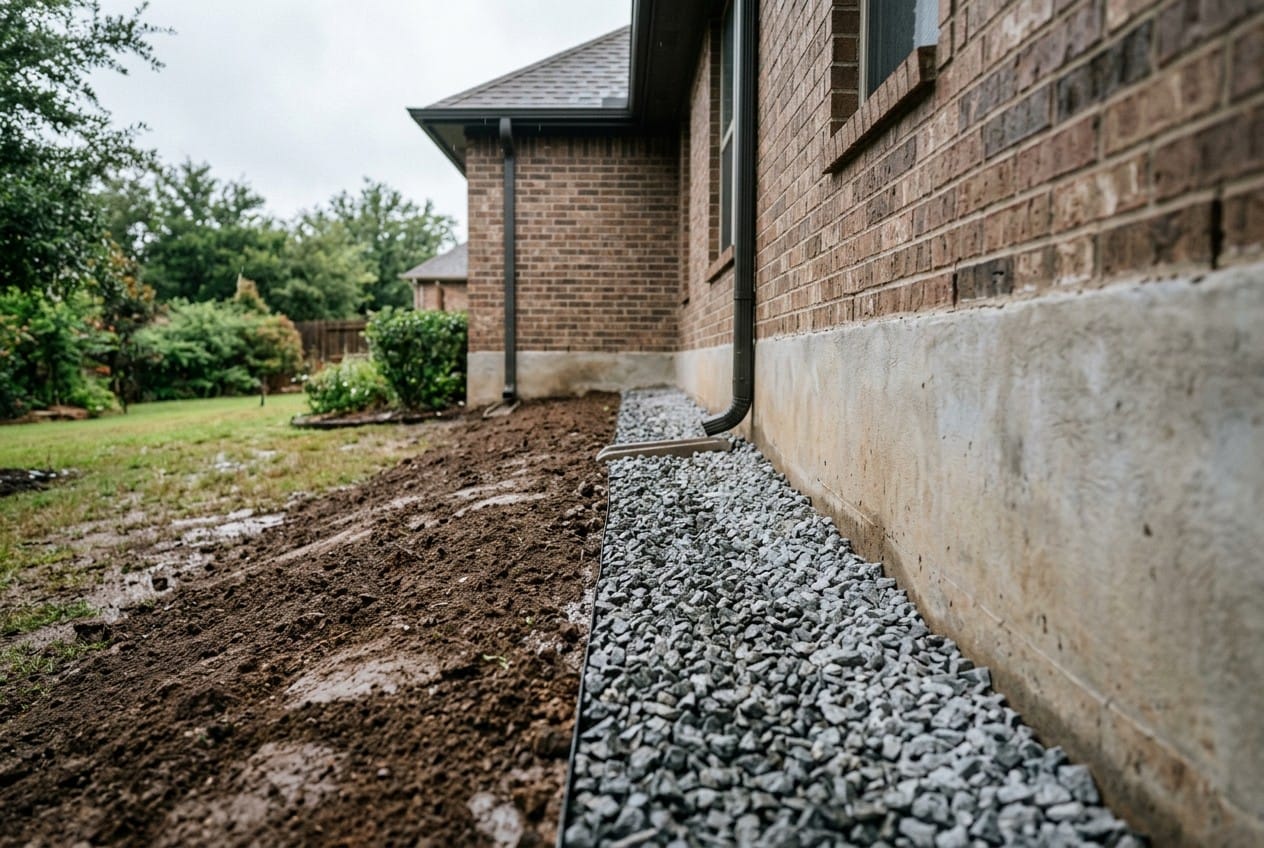
Texas soils are notoriously restless. The expansive clay that underlies much of the state swells after rain and shrinks during drought, creating constant upward and downward pressure on your home’s foundation. Over time that movement adds up — and the earlier you catch it, the cheaper the fix.
Here are the five warning signs every Texas homeowner should know.
1. Diagonal Cracks at Window and Door Corners
Small hairline cracks in drywall are common in any home. The ones that should grab your attention run diagonally from the corners of windows and doorframes — often at a 45-degree angle. This pattern indicates differential settlement: one part of the slab or beam has moved more than the adjacent section.
A single stair-step crack in a brick exterior wall tells the same story. If you’re seeing this pattern in multiple rooms or on the outside of the house, it’s time to call an engineer or foundation contractor.
2. Doors and Windows That Stick or Won’t Close Squarely
When a foundation shifts, door frames and window frames go slightly out of square. You’ll notice:
- Interior doors that drag on the floor or latch only when you lift the handle
- Exterior doors that let light or air in along one edge
- Windows that suddenly require extra force or won’t lock properly
In Texas, this symptom often worsens in late summer after a long dry spell, then eases when fall rains return. If the problem is seasonal and mild, you may be watching normal soil movement. If it’s getting progressively worse over multiple seasons, get an inspection.
3. Gaps Between Walls, Ceilings, and Floors
Walk your home and look for separations:
- Crown molding pulling away from the ceiling
- Baseboards lifting away from the floor
- Visible gaps where interior walls meet the ceiling
These separations happen when different structural elements move at different rates. A gap that grows over months is a more serious indicator than one that’s remained stable for years.
4. Sloping or Uneven Floors
A floor that has a perceptible slope — where a marble rolls to one side of the room — is a classic sign of pier settlement in pier-and-beam homes or slab heave in slab-on-grade homes. You can verify this with a simple 4-foot level.
In pier-and-beam homes, individual piers can sink or wood beams can rot over time, causing localized dips. Slab homes may experience upheaval (upward movement) in the center or settlement at the perimeter. Both conditions are fixable, but the repair method differs significantly.
5. Cracks in the Foundation Itself
If you can see cracks directly in the concrete slab or foundation walls from your basement or crawl space, that is the clearest signal of all. Watch for:
- Horizontal cracks in basement or crawl-space walls — often the most structurally serious
- Vertical or diagonal cracks wider than 1/4 inch in the slab
- Stair-step cracks in concrete block foundation walls
Narrow, stable hairline cracks can result from normal concrete curing. Cracks that are actively growing, wider than a credit card, or accompanied by displacement on one side warrant professional evaluation.
What to Do Next
If you’re seeing two or more of these signs, the prudent step is a professional foundation inspection — most reputable contractors offer them at low or no cost. The inspector will measure floor elevations throughout the home, probe the exterior for moisture patterns, and assess whether any cracks are active or dormant.
You can compare vetted Texas foundation contractors on Foundation Compass to find an inspected provider near you, or browse by city to see who serves your area.
Catching foundation problems early almost always costs less than waiting. A handful of piers installed today is far less expensive than a full perimeter repair after years of unchecked movement.
FAQ
How quickly can a foundation problem get worse?
The pace varies. In extreme drought years — like the ones Texas regularly experiences — clay soils can shrink several inches, and homeowners sometimes see significant new cracking within a single season. More commonly, movement is gradual over years. Either way, a problem that is actively growing should be evaluated soon rather than deferred.
Are foundation cracks covered by homeowner’s insurance?
Most standard homeowner’s policies exclude foundation damage caused by soil movement (settling, shrinkage, or expansion). Coverage may apply if the damage results from a sudden, covered event such as a burst pipe that saturated the soil. Always review your policy and talk to your insurer before assuming coverage.
Do I need a structural engineer or a foundation contractor first?
For straightforward cases — sticking doors, minor cracking — a contractor’s free inspection is a reasonable first step. For complex situations (significant structural cracks, a home that has already been repaired before, or a sale contingency), an independent licensed structural engineer report provides unbiased documentation and is often required by lenders.